
The Anatomy of a Misunderstanding
Feb 28, 2026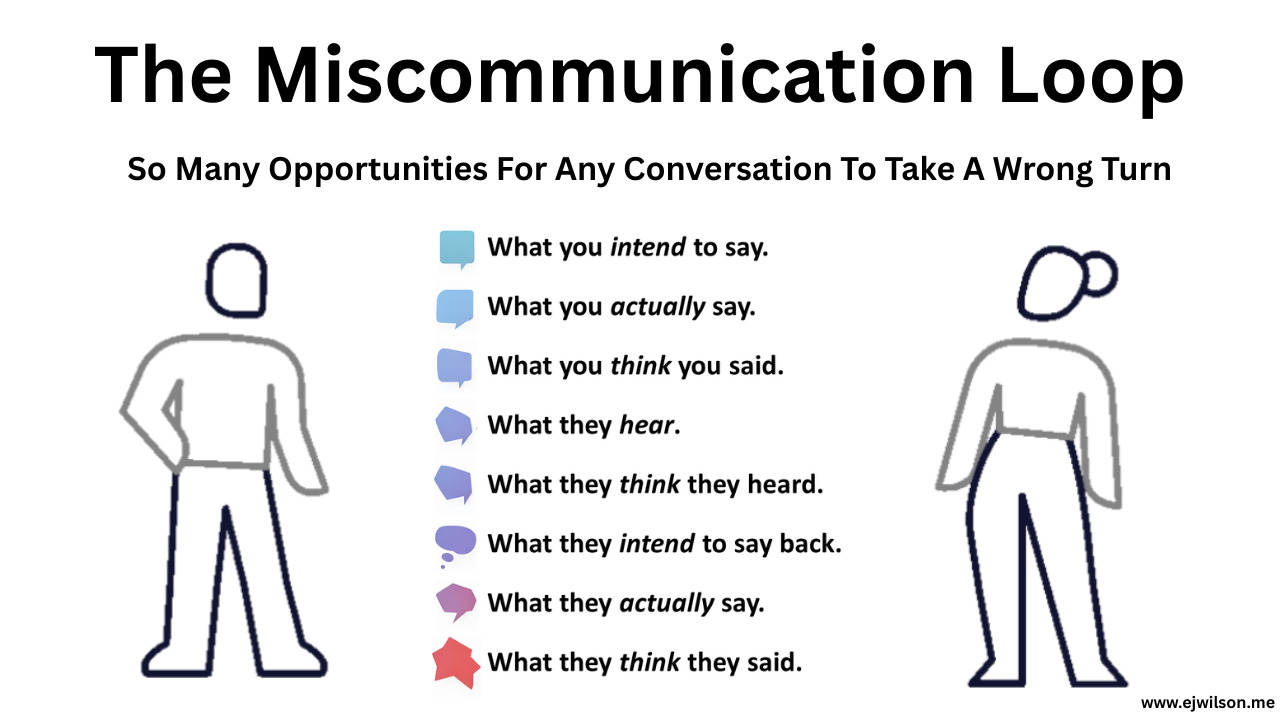
All communication is vulnerable to distortion.
Many conflicts aren't about what happened.
They're often about an interpretation of what happened.
They’re about the version of the issue or event that each person believes is real.
Some studies suggest around 70% of communication may land in the miscommunication category.
Why?
Because when two people talk, there aren’t just 2 clear messages.
There are at least 8 opportunities for communication to go wrong in each back and forth exchange:
- What you intend to say.
- What you actually say.
- What you think you said.
- What they hear.
- What they think they heard.
- What they intend to say back.
- What they actually say.
- What they think they said.
Now multiply that by body language, emotion, tone, past experiences, stress, ego, and assumptions.
And suddenly you’re not even focused on the real topic anymore.
You’re in a back and forth about interpretations of interpretations.
The focus gets lost.
The ego steps in.
The big feelings show up.
The back-and-forth becomes unnecessary off-topic noise.
How can you prevent this cycle?
Before reacting or responding, confirm what you thought you heard.
These simple phrases can help clarify intent before going down the wrong path:
- “Let me play that back to you to see if I understand…”
- “Here’s what I heard… is that correct?”
Pausing to clarify can prevent a lot of miscommunication and misunderstandings.
Especially when something feels unclear or offensive.
Clarity can diffuse tension.
Assumptions often multiply tension.
When I heard Alisa Grace share the 8 ways communication can go wrong at a conference several years ago, my mind was blown by this practical truth.
In theory, I thought this was the easy answer to anybody experiencing communication issues.
In practice, I realized it's a simple idea… but it's not easy to do.
In business, clear communication protects execution.
In relationships, clear communication protects connection.
In leadership, clear communication protects trust.
Miscommunication is normal.
Staying in the pattern it is optional.
Do you confirm what you hear, or just run with what you think you heard?